
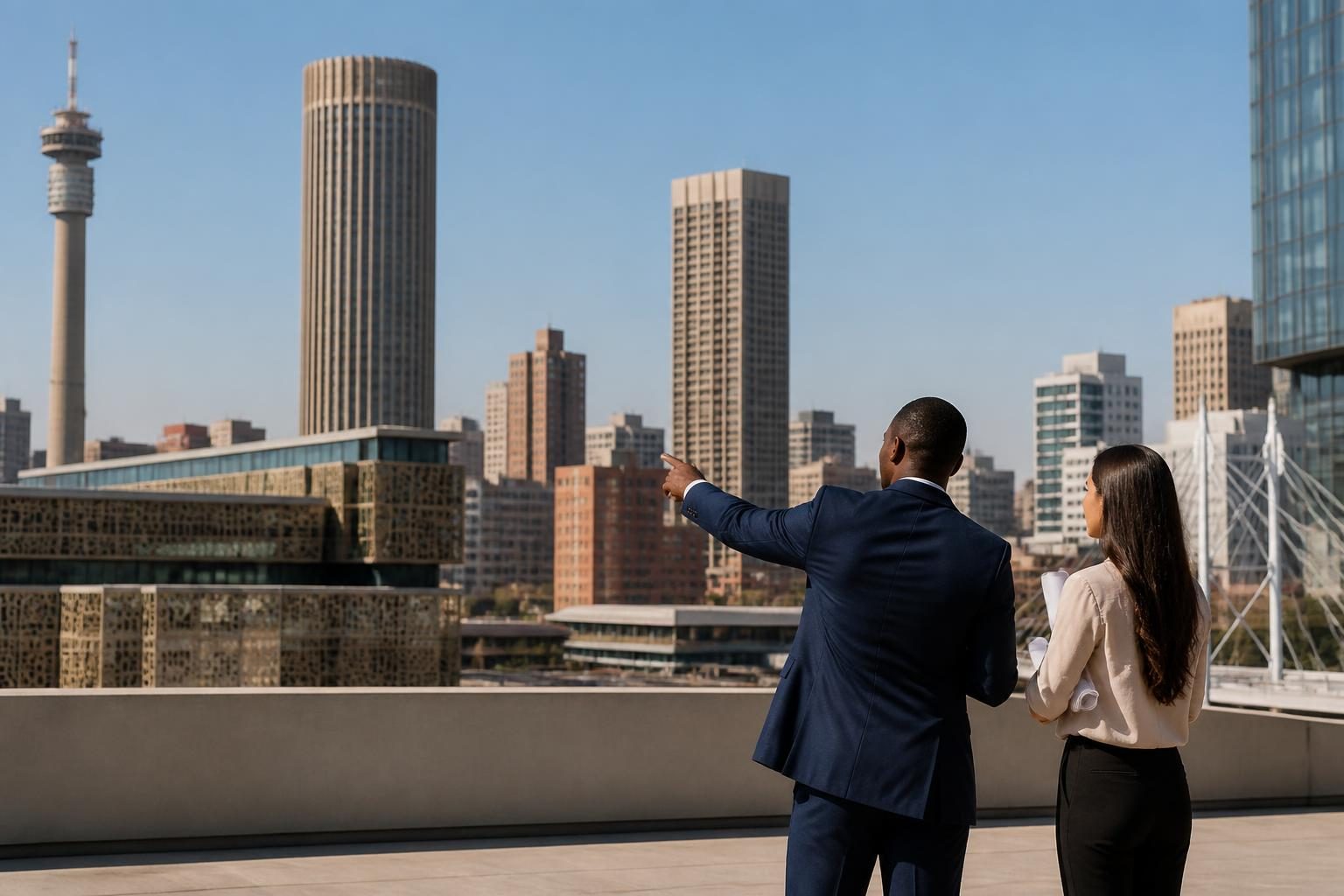
Why these ten landmarks matter for architects and business owners
Johannesburg’s skyline and streets tell a story of extraction, entrepreneurship and reinvention. For architects, developers and buyers, the city’s landmarks are not just photo opportunities — they reveal construction detailing, heritage constraints and commercial patterns that affect feasibility, branding and community engagement. Below are ten must-see sites, with practical takeaways for professionals working in South Africa’s economic heart.
1. Carlton Centre (CBD)
Long regarded as one of Africa’s tallest commercial towers, the Carlton Centre dominates the CBD. Its mixed-use history highlights maintenance and tenancy challenges in central high-rises.
- What to study: vertical circulation, retail podium planning and how large commercial cores age.
- Business angle: lessons for high-rise retrofitting and managing multi-tenant buildings in the inner city.
2. Ponte City (Hillbrow)
The cylindrical silhouette of Ponte City is iconic. It has witnessed cycles of decline and partial regeneration — a case study in managing large residential towers in dense, mixed-use neighbourhoods.
- What to study: concrete façade systems, communal amenity design, and vertical social planning.
- Business angle: potential for specialist residential refurbishment and community-driven property management models.
3. Constitutional Hill (Braamfontein)
This former prison complex now houses the Constitutional Court and museum. The site demonstrates sensitive intervention in a charged historic fabric, balancing new construction and preservation.
- What to study: adaptive reuse of institutional masonry, layering of contemporary additions, visitor circulation.
- Business angle: heritage grading and public-value considerations that affect commercial redevelopment proposals.
4. Apartheid Museum (Ormonde/Gold Reef City)
More than an exhibition space, the museum’s massing and material choices support a narrative experience. It’s a reminder that architecture can intentionally guide interpretation.
- What to study: wayfinding, exhibition flow and robust material palettes for high-traffic public buildings.
- Business angle: cultural attractions boost adjacent retail and hospitality projects — factor visitor flows into feasibility studies.
5. Johannesburg Art Gallery (Joubert Park)
One of the city’s oldest public buildings, the gallery sits within a public park and reflects civic ambitions in early Johannesburg. It shows how institutional buildings anchor public realm improvements.
- What to study: scale relationships between building and public space, daylighting strategies for galleries.
- Business angle: heritage institutions can support area marketing and attract creative tenants.
6. Nelson Mandela Bridge (Newtown)
A contemporary cable-stayed structure that links precincts and signals urban regeneration. Bridges often become visual identifiers and catalysts for precinct investment.
- What to study: structural expression, night-time lighting and pedestrian prioritisation.
- Business angle: improved connectivity increases property values—consider walkability in site selection.
7. Maboneng Precinct (East CBD/Jeppestown)
Maboneng is a high-profile example of warehouse-to-mixed-use transformation: galleries, co-working, housing and retail knit together by branding and curation.
- What to study: adaptive reuse techniques, small-footprint retail integration and placemaking strategies.
- Business angle: curated creative clusters can deliver higher rental premiums but require active management and security solutions.
8. Market Theatre (Newtown)
Born during the apartheid era, the Market Theatre shows how cultural infrastructure can occupy and revitalise industrial buildings.
- What to study: flexible performance spaces, acoustics and backstage logistics in tight urban lots.
- Business angle: cultural anchors support night-time economies; integrate event programming into business plans.
9. Hillbrow Tower (Telkom/Strijdom Tower area)
Telecommunications towers and towers with observation components shape a city’s skyline. Hillbrow Tower is a visual reference point and engineering example of vertical communications infrastructure.
- What to study: service integration around tall structures and maintenance challenges in harsh urban environments.
- Business angle: telecom infrastructure is an amenity for mixed-use projects — check coverage and service provider zones early in planning.
10. Rand Club (Marshalltown)
One of Johannesburg’s classic private clubs, the Rand Club’s heritage interiors and façade detailing reflect the city’s commercial origins and the importance of high-quality civic architecture.
- What to study: period detailing, structural amendments for modern services and the economics of private-club real estate.
- Business angle: heritage status can be a selling point but demands careful cost planning for upgrades.
Visiting tips and practical next steps
Plan visits with a purpose: take photographs of construction joints, note materials and record circulation patterns. For potential investment or design inspiration, check municipal heritage grading and zoning before feasibility work. Engage local architects and heritage consultants early — they know permit pathways and conservation incentives.
Finally, use these landmarks as benchmarks. Whether you’re proposing an adaptive reuse, a new office or a mixed-use development, Johannesburg’s buildings offer concrete lessons in durability, social context and commercial viability.