
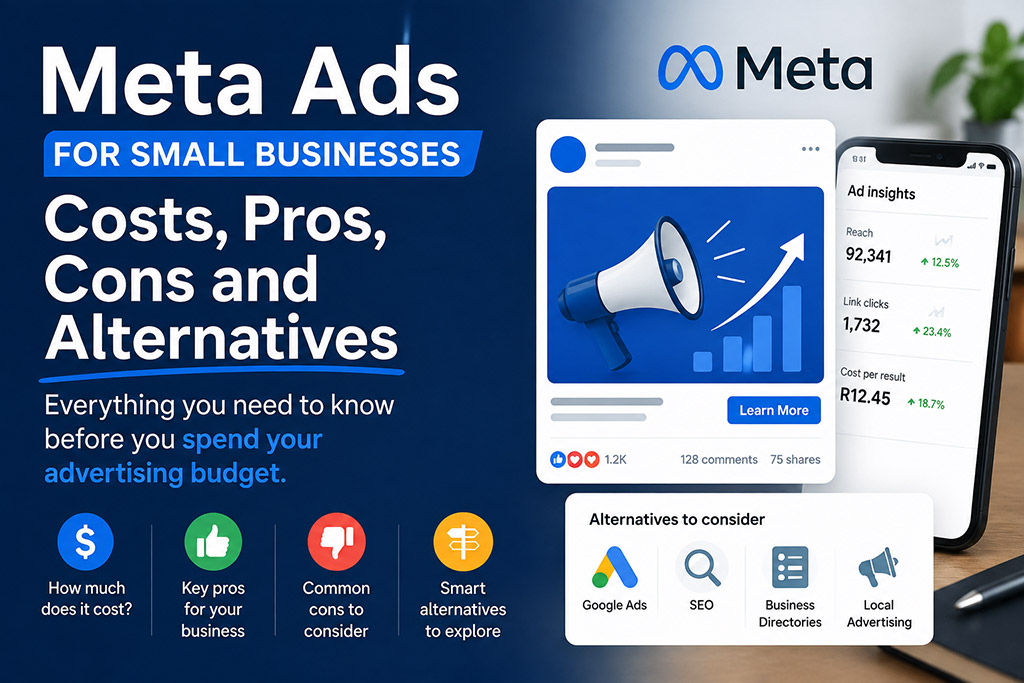
Meta Ads are attracting growing attention from South African businesses. Google Keyword Planner data for South Africa shows about 1,900 monthly searches for “Meta Ads”, up 123% year on year.
But using Meta Ads profitably is more complicated than boosting a post. The important question is not “How cheap can I get clicks?” It is: How much can I afford to pay to acquire a real customer?
What do Meta Ads actually cost?
Meta does not have a fixed rate card. Ads compete in an auction, and delivery is influenced by factors including your bid, the likelihood that someone will take the desired action and the quality of the advert.
You choose a daily or lifetime budget. Meta says there is no universal minimum budget, and daily budgets are averages rather than rigid daily spending limits.
For a small business, four numbers matter:
- Cost per click
- Cost per lead
- Cost per customer
- Customer value
The last two matter most.
Suppose an accountant earns R3,000 in gross profit from a new client and is willing to spend 30% of that profit acquiring the client. The maximum acceptable acquisition cost is R900.
If only one in five enquiries becomes a customer, the business can afford roughly R180 per qualified lead.
If Meta produces qualified leads at R80, the numbers may be excellent. At R300 per lead, the campaign probably needs improvement — regardless of how many likes or clicks it receives.
Also choose the campaign objective that matches the result you actually want. Meta can optimise campaigns for objectives such as traffic, engagement, leads or sales. If you need enquiries, optimising purely for cheap traffic can give you visitors without enough customers.
How much should a small business test with?
There is no magic starting figure, but a small budget should be concentrated rather than scattered.
If you have R1,500 to test, splitting it across ten audiences and six different offers gives each one very little opportunity to prove itself.
A better first test would usually concentrate on one clear offer, one main campaign, a limited number of audiences and several different adverts.
A practical initial test could run for roughly 7–14 days.
What you want to learn is simple:
- Which advert gets attention?
- Which audience responds?
- What does a genuine lead cost?
- Do those leads become paying customers?
Increase spending when the answers look promising — not simply because Meta is delivering lots of impressions.
Where Meta Ads can be very good
Meta is particularly useful when your business benefits from discovery.
A person may not search Google for a wedding venue, photographer, training course, furniture maker or landscaping company today — but an attractive advert can introduce the business and create interest.
Meta Ads can make particular sense when:
- Your product or service is visually appealing
- Customers can be persuaded by a strong offer
- You understand roughly who your ideal customer is
- You want people to message, call or submit an enquiry
- You have existing audiences you can re-engage
For service businesses, click-to-message ads can also send prospective customers directly into Messenger, Instagram Direct or WhatsApp.
For a restaurant, photographer, property agent, furniture company or event venue, this ability to create demand can be powerful.
Where Meta Ads can disappoint
The biggest weakness is intent.
Someone scrolling through Instagram has not necessarily decided to buy anything.
Compare that with someone typing:
“emergency plumber Sandton”
into Google.
The Google searcher has already declared a need.
That means a Meta campaign can sometimes generate cheap enquiries that are not necessarily good enquiries.
There are three other problems small businesses should watch carefully.
Creative fatigue
An advert that performs well initially can become less effective after the same audience repeatedly sees it.
Poor measurement
One hundred leads mean very little if nobody tracks how many became customers.
Budget dependency
Paid exposure generally depends on continued advertising spend.
That is fine when the advertising is profitable, but dangerous when a business becomes dependent on one paid channel.
Meta Ads alternatives worth considering
Google Ads
Google Ads can be stronger when customers already know what they need and are actively searching for it.
Plumbers, accountants, lawyers, electricians and other need-driven services can benefit from appearing at the moment someone searches.
Search engine optimisation
SEO usually takes longer, but good search visibility can continue producing visitors without paying for every individual click.
Business directories
Business directories give businesses another place where customers can discover their services, location and contact information.
They can be particularly useful when customers are comparing local service providers.
Email marketing
An existing customer or prospect database can generate repeat sales and enquiries without paying an advertising platform for every interaction.
Referrals and partnerships
Recommendations and strategic partnerships can be especially valuable for service businesses where trust matters.
The strongest strategy may therefore be a combination rather than dependence on Meta alone.
Should your business use Meta Ads?
Meta Ads make sense when you have a clear offer, an identifiable audience, good creative and a way to measure whether enquiries actually become customers.
Avoid spending money simply because you feel your business “needs more exposure”.
Before launching a campaign, answer three questions:
- What is one new customer worth?
- How much am I prepared to spend to acquire that customer?
- What exactly do I want someone to do after seeing the advert?
If you cannot answer those questions, solve that problem before increasing your advertising budget.
What The Business List offers
The Business List gives South African businesses another way to maintain visibility online.
Instead of paying for every click, one payment provides a detailed business listing that remains available to potential customers for the duration of your package.
For many small businesses, the sensible approach is to combine paid advertising with a strong website, search visibility, social media and business listings that continue giving customers opportunities to find you even when an individual advertising campaign is switched off.